Evidence summary
What it does: Cofactor in multiple enzymatic steps of steroid synthesis.
Effective use: Correcting a deficiency. 15 to 30mg daily as a supplemental dose.
Upper limit: 40mg per day from all sources, per NIH.
Key point: More is not better once you are replete.
The deficiency experiment
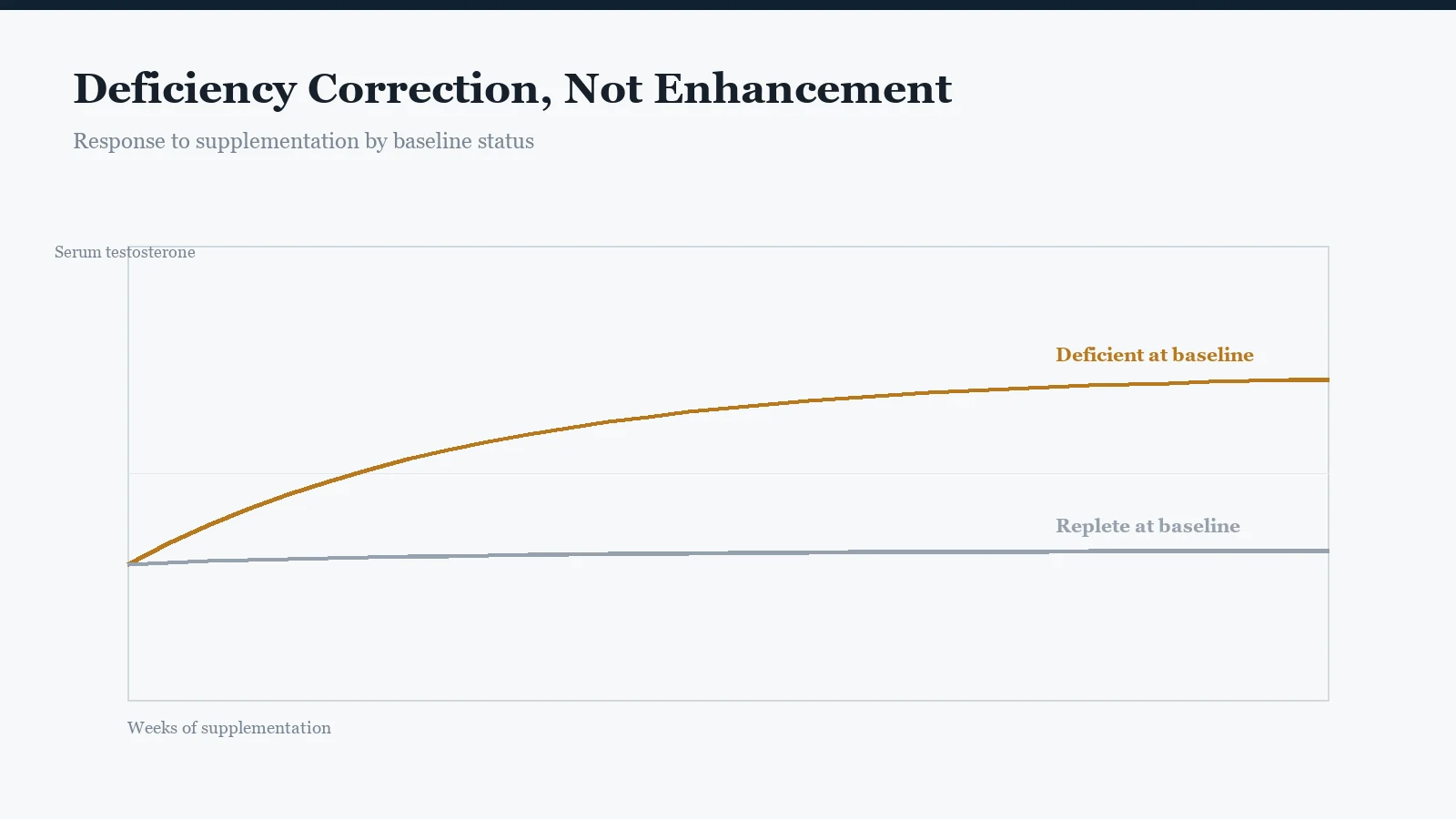
The foundational work here is unusually clean. Experimentally induced dietary zinc restriction in healthy young men produced a marked fall in serum testosterone, and repletion restored it. In the same body of work, supplementation in marginally zinc-deficient older men roughly doubled serum testosterone over six months.1
That establishes necessity: without adequate zinc, testosterone synthesis is impaired.
What it does not establish is that additional zinc raises testosterone in a man who is already replete. It does not. Marketing frequently cites the deficiency studies as though they were supplementation studies in the general population, which is a category error and the single most common misrepresentation in this ingredient's promotion.
The upper limit is a formulation issue
The NIH tolerable upper intake level for adults is 40mg per day from all sources, including food and any other supplement.2 Chronic intake above that interferes with copper absorption and can produce a secondary copper deficiency, with consequences for haematological function.
Several products in the testosterone category sit at or above 40mg of zinc in a single daily serving. That is a formulation choice worth noticing, particularly if you take a multivitamin as well. A supplemental dose in the 15 to 30mg range leaves headroom for dietary intake.
Form and absorption
Zinc bisglycinate, picolinate and citrate are better absorbed than zinc oxide, which is the cheapest and the most common in low-cost products. As with magnesium, a label that states a zinc quantity without naming the form is providing incomplete information.
Who is likely to be deficient
- Men on predominantly plant-based diets, since phytates reduce zinc absorption
- Endurance athletes, through losses in sweat
- Older adults, through reduced intake and absorption
- Anyone with a malabsorptive gastrointestinal condition
Bottom line
Zinc belongs in a testosterone formula as insurance against a common and consequential deficiency, at 15 to 30mg in a well-absorbed form. It is not the active mechanism a product should be sold on, and a formula whose hormonal case rests primarily on zinc is thin. Doses at or above 40mg are a reason for caution rather than a selling point.
References
- Prasad AS, Mantzoros CS, Beck FW, Hess JW, Brewer GJ. Zinc status and serum testosterone levels of healthy adults. Nutrition. 1996;12(5):344-348.
- National Institutes of Health, Office of Dietary Supplements. Zinc: Fact Sheet for Health Professionals.