Most discussion of falling testosterone starts from anecdote. The underlying data is more specific, and more unusual, than the popular framing suggests.
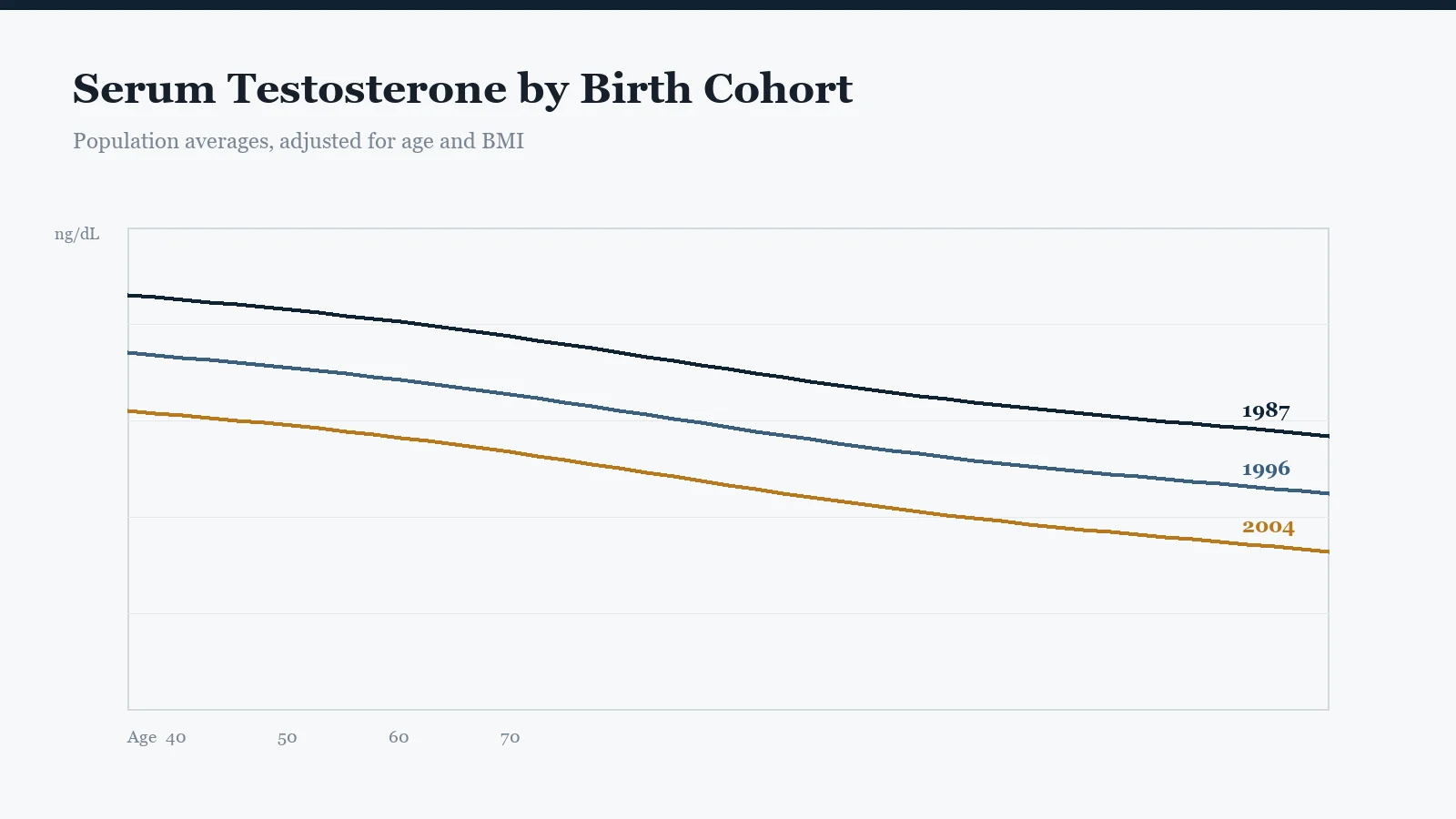
The Massachusetts Male Aging Study followed a randomly sampled cohort of men in the Boston area across three waves between 1987 and 2004. When Travison and colleagues analysed the results, they found something that age alone does not explain: at any given age, men tested later in the study period had lower total testosterone than men of the same age tested earlier.1
The magnitude was roughly a 1% decline per year in population averages, on top of the individual decline that comes with ageing. A 60-year-old in 2004 averaged around 15% lower total testosterone than a 60-year-old in the same population 16 years earlier.
Why this finding is unusual
The decline persisted after statistical adjustment for age, obesity, smoking status and medication use. Those adjustments matter: they rule out the most obvious confounders and leave a cohort effect that is still not fully explained.
What the candidate explanations are
Adiposity, but not only adiposity
Adipose tissue expresses aromatase, the enzyme that converts testosterone to estradiol, so rising population BMI is a mechanically plausible driver. The complication is that the cohort effect survived BMI adjustment. Obesity is clearly a strong individual-level determinant, but it does not appear sufficient to account for the generational shift on its own.
Endocrine-disrupting compounds
Exposure to compounds that interfere with hormone signalling has risen over the same period. Phthalates and bisphenols are the most studied, and several show anti-androgenic activity in laboratory models. Human evidence is largely observational and inconsistent in effect size, so the honest position is that this is a plausible contributor with incomplete proof rather than an established cause.
Sleep duration
Reported sleep duration has declined over comparable periods, and the experimental evidence here is unusually clean. Restricting healthy young men to five hours a night for one week reduced daytime testosterone by 10 to 15%.2 That is a controlled experimental effect, not a correlation, which puts it on firmer ground than most environmental hypotheses. We cover it in detail in our review of sleep and overnight production.
Physical activity and muscle mass
Resistance training and lean mass both associate with higher testosterone. Population-level shifts toward sedentary work are consistent with the trend, though the direction of causation is difficult to isolate in observational data.
What this does and does not mean for an individual
A population trend is not a diagnosis. Serum testosterone varies widely between healthy men, and it fluctuates within the same man across the day and between days. A single measurement, particularly one taken in the afternoon, tells you very little.
If symptoms suggest a genuine deficiency, the standard approach is total and free testosterone measured in the morning on two separate occasions, interpreted alongside LH and FSH. Clinically low levels are a medical matter. The supplement category we review addresses nutritional and botanical support for men whose levels are within range but suboptimal, which is a different question entirely.
The modifiable factors that the literature supports most clearly are unglamorous: visceral fat, sleep, resistance training, and correcting deficiencies in zinc, magnesium and vitamin D where they exist.
References
- Travison TG, Araujo AB, O'Donnell AB, Kupelian V, McKinlay JB. A population-level decline in serum testosterone levels in American men. Journal of Clinical Endocrinology and Metabolism. 2007;92(1):196-202.
- Leproult R, Van Cauter E. Effect of 1 week of sleep restriction on testosterone levels in young healthy men. JAMA. 2011;305(21):2173-2174.