Testosterone secretion is not evenly distributed across the day. It follows a circadian rhythm that peaks in the early morning, and the bulk of daily production occurs during sleep, rising with the onset of the first deep sleep episode and tracking sleep architecture through the night.
That mechanism makes a testable prediction: restrict sleep, and daytime testosterone should fall. It does.
The key experiment
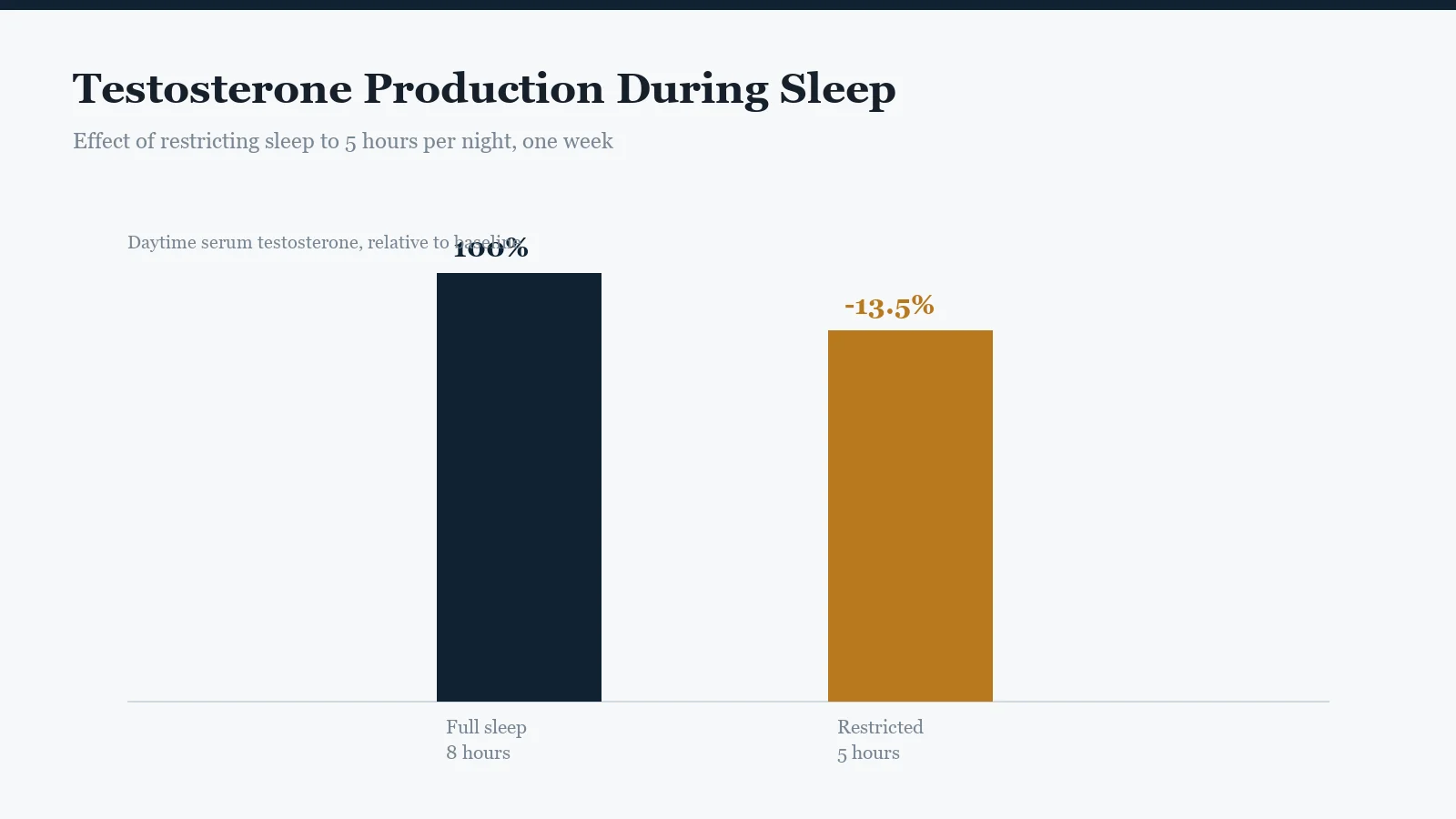
Leproult and Van Cauter restricted ten healthy young men to five hours in bed per night for one week under controlled laboratory conditions. Daytime testosterone fell by 10 to 15% compared to their own baseline after full sleep.1 The effect appeared within a week, in young men with no underlying pathology.
Two features of that study deserve emphasis. It was a within-subject design, so each participant served as his own control, which removes between-person variability. And the participants were young and healthy, meaning the effect was not an artefact of pre-existing deficiency.
The size of the effect in context
A 10 to 15% reduction is comparable to roughly a decade of age-related decline, produced in one week by sleep restriction alone. That framing is worth sitting with, because sleep is one of the few variables in male hormonal health that is both highly modifiable and supported by experimental rather than observational evidence.
Sleep apnoea is a separate and larger problem
Obstructive sleep apnoea fragments sleep architecture and suppresses the nocturnal rise in testosterone, and the association with reduced levels is well documented. It also frequently goes undiagnosed in exactly the demographic most likely to be searching for testosterone support.
If you snore heavily, wake unrefreshed despite adequate time in bed, or have been told you stop breathing during sleep, that warrants investigation before any supplement. No formulation compensates for untreated apnoea.
What actually helps
- Duration first. Seven to nine hours in bed, consistently. This is the variable with the direct experimental evidence behind it.
- Regularity second. A stable sleep and wake time stabilises circadian signalling more effectively than compensating on weekends.
- Alcohol before bed. It shortens sleep latency but suppresses REM and fragments the second half of the night.
- Temperature and light. A cool, dark room supports the deep sleep episodes during which most secretion occurs.
Several botanicals marketed for sleep also appear in testosterone formulas, ashwagandha being the most common. The rationale is indirect but not unreasonable: lowering cortisol supports sleep quality, and sleep quality supports overnight production. We examine that evidence in our ashwagandha review, and how it appears in commercial formulas in our comparative ranking.
References
- Leproult R, Van Cauter E. Effect of 1 week of sleep restriction on testosterone levels in young healthy men. JAMA. 2011;305(21):2173-2174.
- Wittert G. The relationship between sleep disorders and testosterone in men. Asian Journal of Andrology. 2014;16(2):262-265.