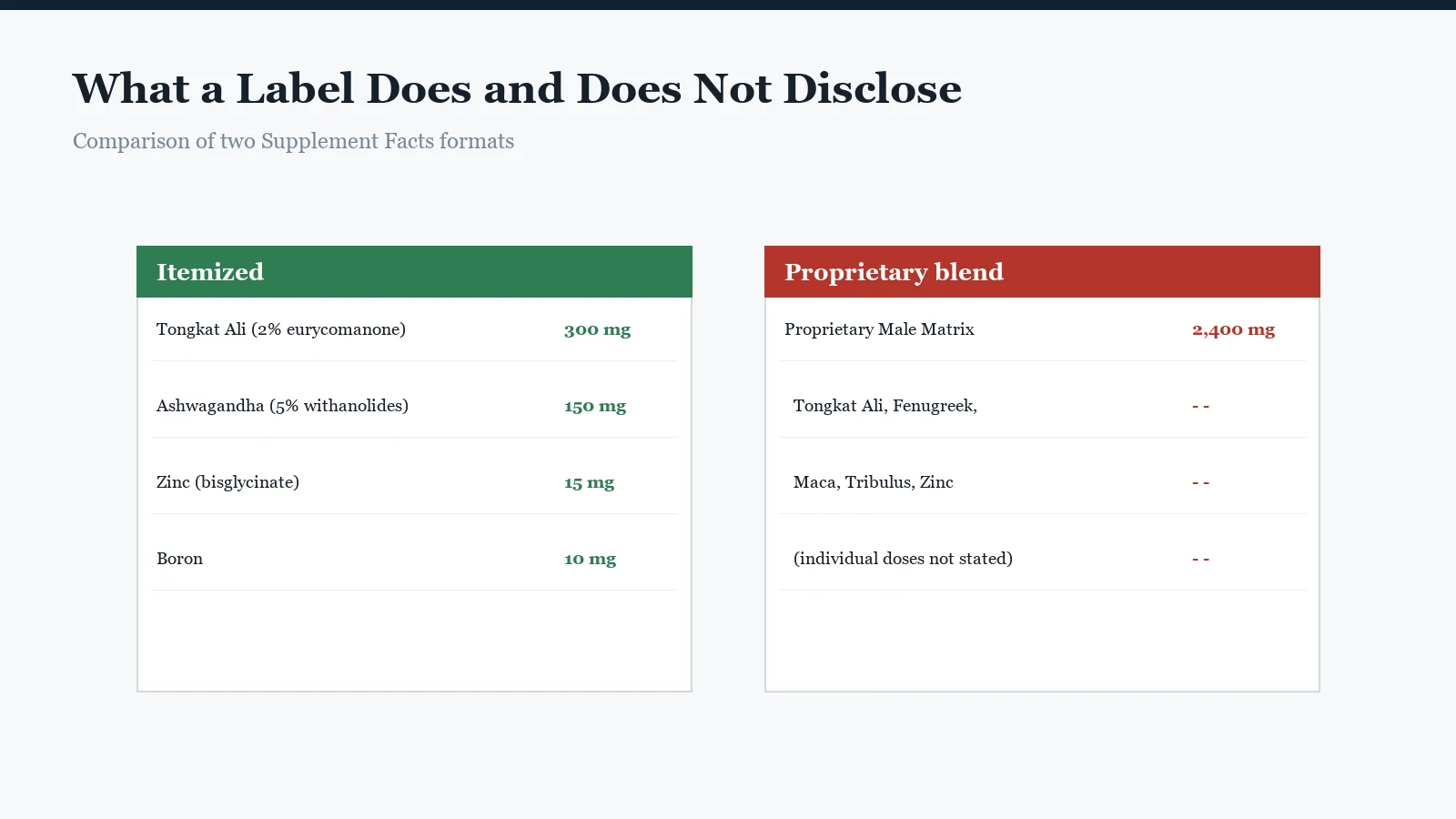
Dietary supplements in the United States are not evaluated for efficacy before they reach the market. Under DSHEA, the burden falls on the regulator to demonstrate a problem after the fact, primarily on safety grounds.1 Whether the formula does anything is not assessed.
Within that framework, the practices below are all lawful. Each one prevents a buyer from comparing a product against the published evidence.
1. The proprietary blend
Ingredients are grouped under a trade name with only the combined total disclosed. Regulation requires that components be listed in descending order by weight, and nothing more.2 A 2,400mg blend can therefore consist of 2,300mg of the cheapest ingredient and trace quantities of everything else, with no way to tell from the label.
2. Herb-equivalent dosing
A label states "Panax ginseng 8,000mg" with "from 40:1 extract" in smaller type. The capsule contains 200mg of extract; the 8,000mg figure describes the raw plant material it was derived from. Concentration ratios are legitimate chemistry. Printing the pre-extraction weight as the headline figure is a marketing decision.
3. Unstandardized botanical extracts
Two products both list "Tongkat ali extract 300mg". One is standardized to a stated percentage of eurycomanone, the compound the human trials were conducted on. The other is milled root of unknown active content. Without a named marker compound and a percentage, a botanical dose carries little information. This is the single most consequential omission in this category.
4. Underdosing a well-known active
A recognisable, well-studied ingredient appears on the label at a fraction of any studied dose. Ashwagandha at 50mg against a trial range of 240 to 600mg, for instance. The ingredient is present so that it can be named on the front of the package.
5. Claim transfer
A product states that an ingredient "has been clinically shown" to produce an effect, while containing a fraction of the dose used in that research. The claim attaches to the compound in the abstract, not to the quantity in the capsule. Comparing the label dose against the trial dose is the only way to check.
6. Serving-size arithmetic
A low bottle price can conceal a high daily cost when the serving is five or six capsules. Cost per day at the full labelled serving, and cost per active that reaches a studied dose, are the comparable figures.
A 30-second check
Every active carries an exact milligram figure. Botanical extracts name a marker compound and a percentage. Headline numbers are not herb equivalents. Doses match the published trial range. Cost is calculated per day at the full serving.
We applied exactly this checklist, formalised into a weighted rubric, in our comparative review of five testosterone formulas. Two of the five failed the first check.
References
- U.S. Food and Drug Administration. Dietary Supplement Health and Education Act of 1994, regulatory framework overview.
- Code of Federal Regulations, Title 21, Section 101.36. Nutrition labeling of dietary supplements.