Eurycoma longifolia, commonly sold as tongkat ali or longjack, is the botanical most frequently positioned as the active centrepiece of natural testosterone formulas. It is also the ingredient where the gap between the research and the retail product is widest.
What the human evidence supports
The most frequently cited trial examined moderately stressed adults receiving a standardized water extract for four weeks. It reported reductions in cortisol and improvements in mood state measures, alongside a modest increase in testosterone.1 Additional work has examined effects in men with reduced baseline levels and in older adults, with generally supportive but heterogeneous results.
The effect sizes are moderate rather than dramatic. Tongkat ali is not a pharmaceutical intervention and should not be presented as one.
The critical detail
These trials used extracts standardized to a stated content of eurycomanone, the principal quassinoid, or to a defined extraction ratio. The evidence attaches to that material. It does not transfer automatically to any product listing "tongkat ali" on its label.
Why unstandardized material is a different product
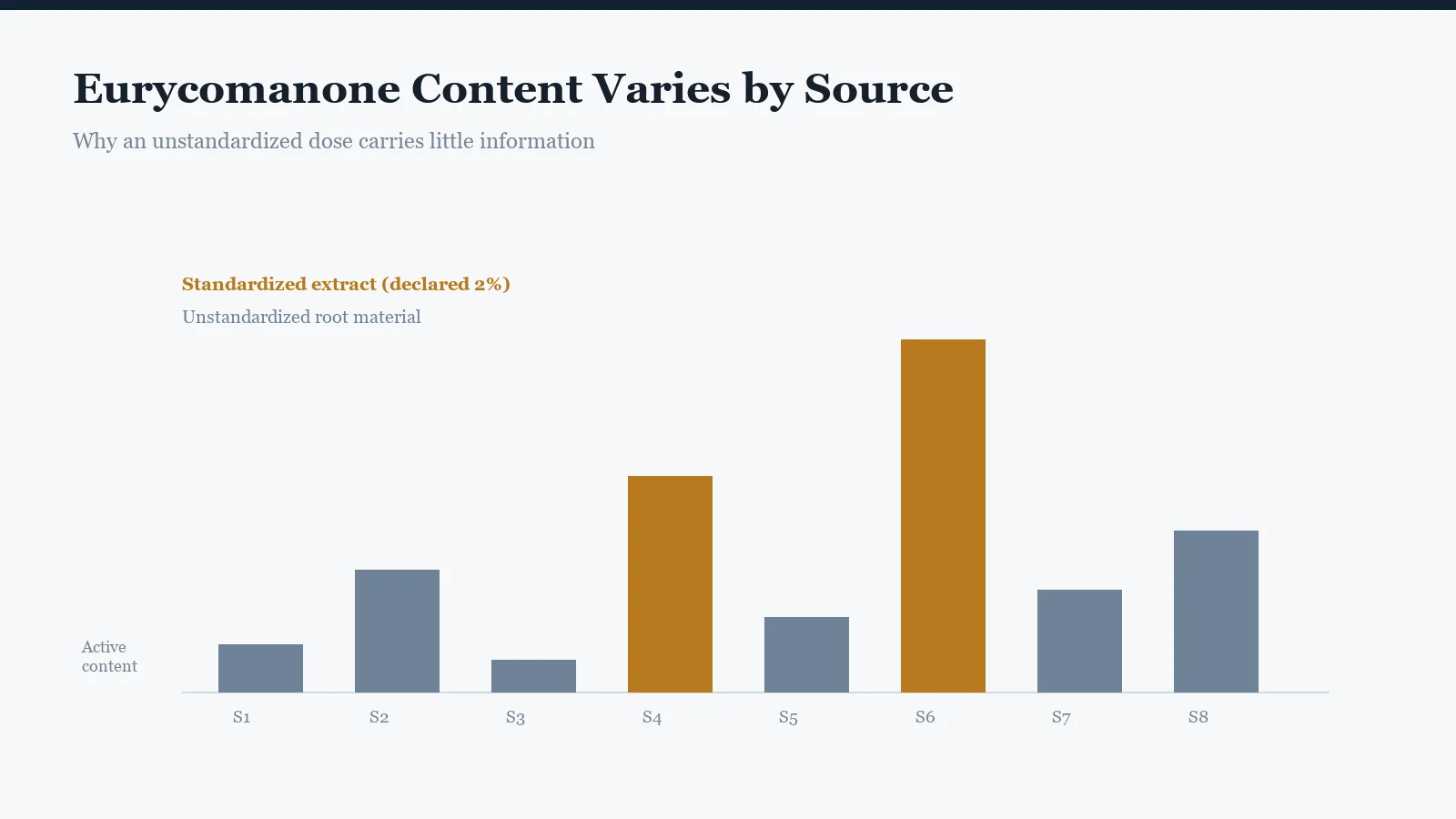
Quassinoid content in Eurycoma longifolia root varies with plant age, growing region, part of the plant used and extraction method. Root harvested young, or extracted with a method not designed to concentrate quassinoids, can contain a small fraction of the active content of the material used in trials.
A label reading "Tongkat Ali 300mg" therefore describes mass, not activity. A label reading "Tongkat Ali (standardized to 2% eurycomanone) 300mg" describes both. Only the second permits any comparison to the literature.
What to look for
- A named marker compound, eurycomanone, with a stated percentage, or a defined extraction ratio such as 100:1 or 200:1
- A disclosed milligram dose rather than inclusion inside a proprietary blend
- Third-party testing, ideally to an ISO 17025 accredited laboratory
In our comparative review, standardization to eurycomanone was one of the main differentiators between the highest and lowest scoring formulas. Two products listed tongkat ali without naming any marker compound.
Safety and interactions
Human trials at typical supplemental doses report a favourable safety profile over the durations studied, which are generally weeks to months rather than years. Long-term data is limited. As with any botanical affecting endocrine parameters, it is not appropriate for men with hormone-sensitive conditions without medical supervision, and anyone on prescription medication should consult a clinician first.
References
- Talbott SM, Talbott JA, George A, Pugh M. Effect of Tongkat Ali on stress hormones and psychological mood state in moderately stressed subjects. Journal of the International Society of Sports Nutrition. 2013;10:28.
- Henkel RR, Wang R, Bassett SH, et al. Tongkat Ali as a potential herbal supplement for physically active male and female seniors. Phytotherapy Research. 2014;28(4):544-550.