Three micronutrients appear in nearly every testosterone formula on the market: zinc, magnesium and vitamin D. All three have genuine mechanistic roles in steroidogenesis. All three are also routinely misrepresented in marketing.
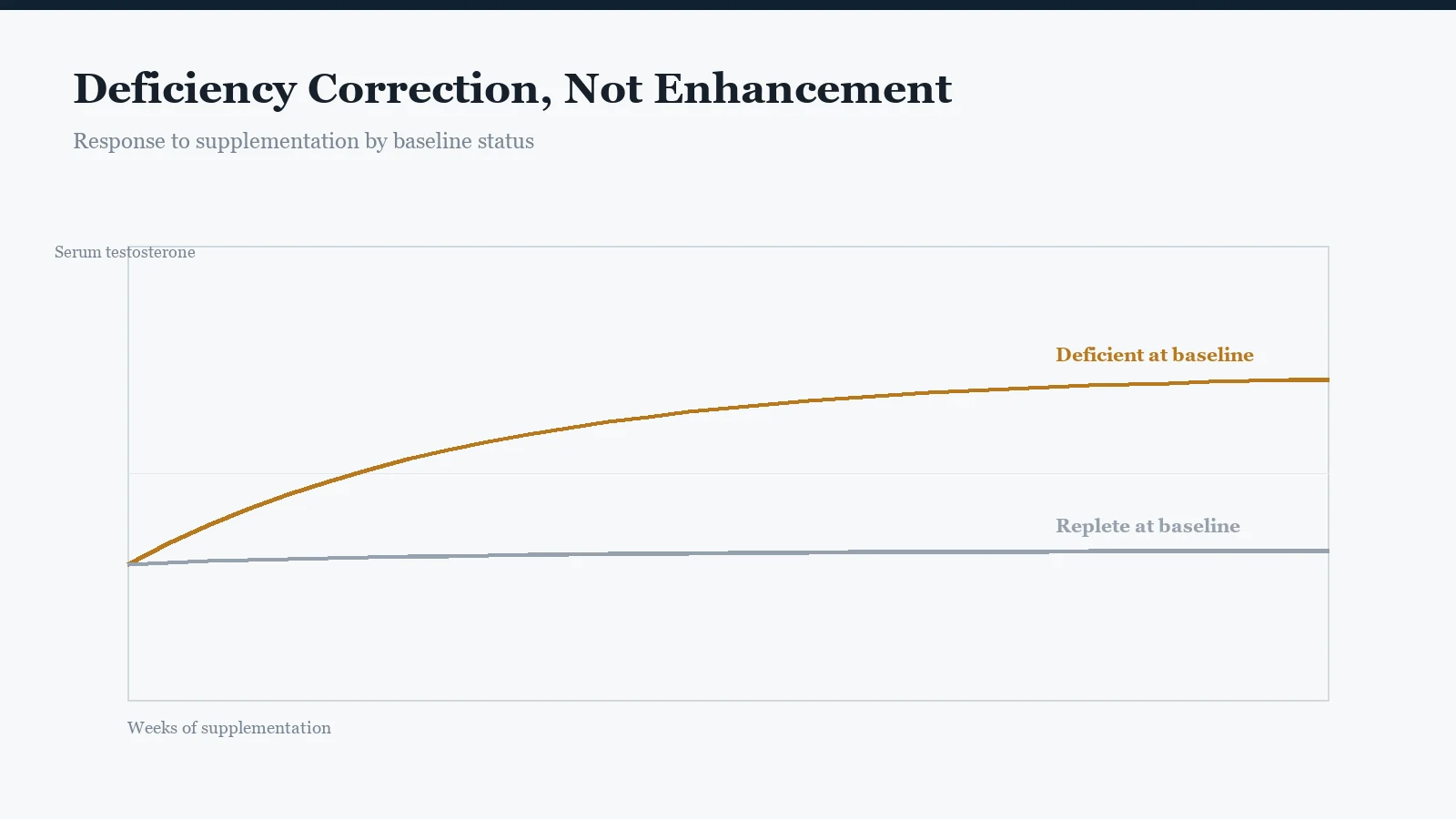
The pattern across the literature is consistent. Correcting a deficiency produces a measurable change in hormonal parameters. Supplementing beyond sufficiency does not produce further gains.
Zinc
Zinc is a cofactor in multiple enzymatic steps of steroid synthesis, and experimentally induced dietary zinc restriction reduces serum testosterone in healthy men, with restoration on repletion.1 That is a clean demonstration of necessity.
What it does not demonstrate is that additional zinc raises testosterone in a man who is already replete. It does not. Marketing frequently cites the deficiency studies as though they were supplementation studies in the general population, which is a category error.
Dose matters for a second reason. The NIH tolerable upper intake level for adults is 40mg per day from all sources, and chronic intake above that threshold interferes with copper absorption.2 Several products in this category sit at or above 40mg, which is a formulation choice worth noticing.
Magnesium
Magnesium is involved in hundreds of enzymatic reactions and appears to influence the fraction of testosterone bound to sex hormone binding globulin. Intake below recommended levels is common in Western diets, which makes correction a reasonable target.
The form determines how much you actually absorb. Magnesium oxide is the cheapest and the most poorly absorbed; citrate, glycinate and malate perform considerably better. A label stating a large magnesium figure without naming the form is providing incomplete information.
Vitamin D
Vitamin D functions as a steroid hormone, and receptors are present in testicular tissue. Observational studies consistently associate higher serum 25-hydroxyvitamin D with higher testosterone. Intervention trials are more mixed, and the most defensible reading is again a correction effect: supplementation helps men who are deficient, with limited evidence of benefit in those who are replete.
Deficiency is common, particularly at higher latitudes and in winter, which makes it worth measuring rather than assuming in either direction.
Practical implication
These three are worth including in a formula as insurance against a common deficiency. They are not the active mechanism a product should be sold on, and a formula whose hormonal case rests primarily on them is thin.
How the commercial formulas handle these three, including which sit at the zinc upper limit, is covered in our comparative ranking.
References
- Prasad AS, Mantzoros CS, Beck FW, Hess JW, Brewer GJ. Zinc status and serum testosterone levels of healthy adults. Nutrition. 1996;12(5):344-348.
- National Institutes of Health, Office of Dietary Supplements. Zinc: Fact Sheet for Health Professionals.
- Pilz S, Frisch S, Koertke H, et al. Effect of vitamin D supplementation on testosterone levels in men. Hormone and Metabolic Research. 2011;43(3):223-225.