Evidence summary
What it is: Root extract of Eurycoma longifolia, a Southeast Asian shrub.
Studied dose: 200 to 400mg daily of a standardized extract.
Evidence quality: Moderate. Several small randomized trials, heterogeneous protocols.
Key requirement: Standardization to eurycomanone. Without it, dose is uninformative.
What the human trials show
The most frequently cited study examined 63 moderately stressed adults receiving 200mg daily of a standardized water extract for four weeks. It reported a reduction in salivary cortisol of around 16% and an increase in testosterone of approximately 37%, alongside improvements in tension, anger and confusion scores.1
Subsequent work has looked at older adults and at men with reduced baseline levels. A study in physically active seniors reported improvements in free testosterone and muscular force after five weeks of supplementation.2 Effects are generally more visible in men whose baseline is low or who are under measurable stress, which is a pattern that recurs across this entire category.
The honest summary is that the effect sizes are moderate, the trials are small, and the protocols vary enough that pooling them is difficult. Tongkat ali is not a pharmaceutical intervention and any source presenting it as one is overselling.
The mechanism
Two mechanisms are proposed, and they are not mutually exclusive.
The first is a reduction in cortisol. Because glucocorticoids suppress gonadal steroidogenesis, lowering chronic cortisol removes a brake on testosterone production. This is consistent with the observation that effects are clearest in stressed populations.
The second is an effect on the fraction of testosterone bound to sex hormone binding globulin. Quassinoids, of which eurycomanone is the principal one in this plant, appear to influence the free versus bound ratio, which matters because only unbound testosterone is biologically active.
Why standardization decides everything
This is the single most consequential point on this page.
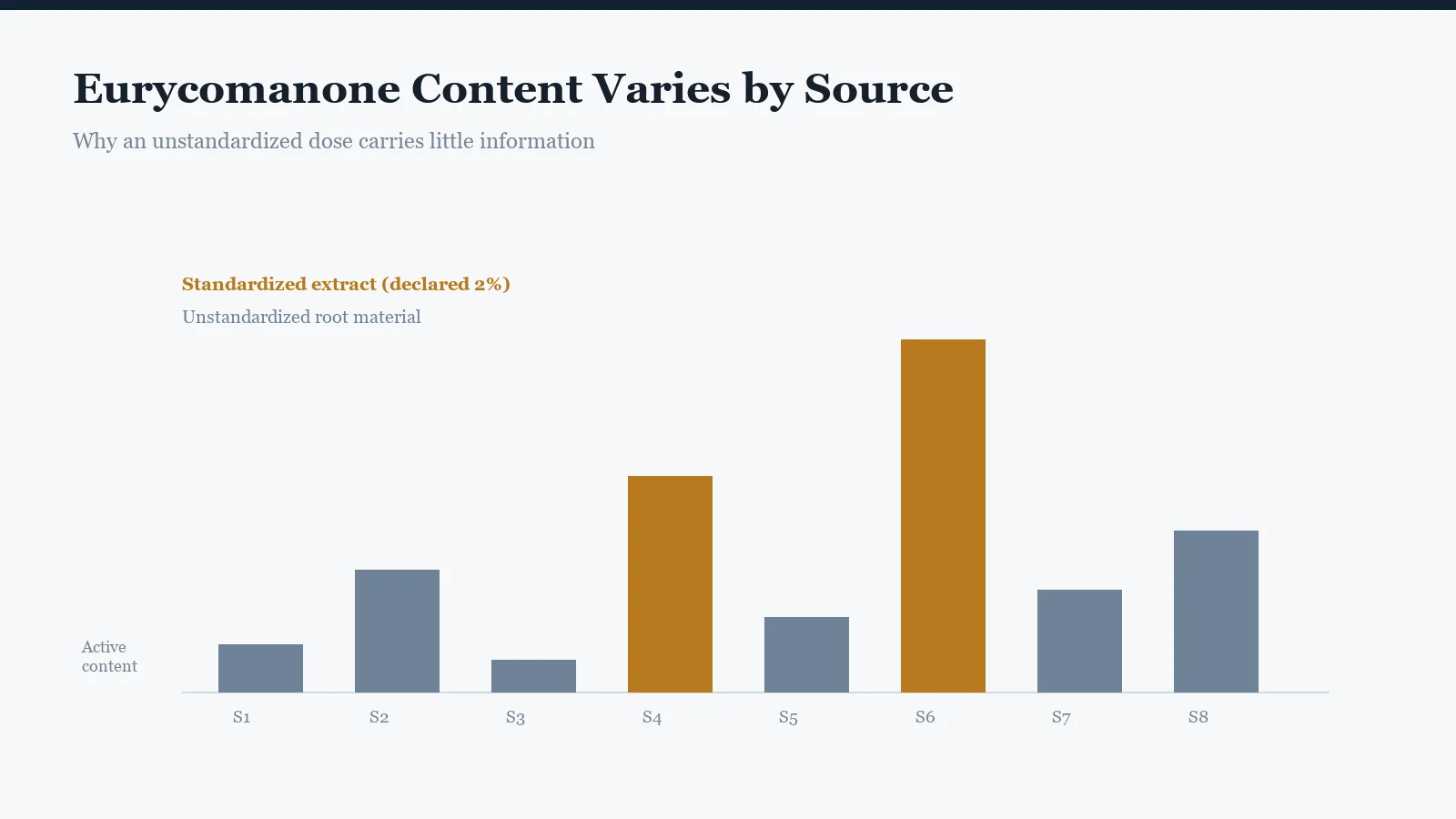
Quassinoid content in Eurycoma longifolia root varies with plant age, growing region, which part of the plant is harvested and how the extraction is performed. Root harvested young, or extracted by a method not designed to concentrate quassinoids, can contain a small fraction of the active content of the material used in the published trials.
A label reading "Tongkat Ali 300mg" therefore tells you the mass of plant material in the capsule. It tells you nothing about how much eurycomanone is present, and those two figures can differ by an order of magnitude between products.
A label reading "Tongkat Ali extract (standardized to 2% eurycomanone) 300mg" tells you both. Only the second permits any comparison against the literature. We cover the general pattern in our guide to reading a supplement label.
What to look for on a label
- A named marker compound, eurycomanone, with a stated percentage, or a defined extraction ratio such as 100:1 or 200:1
- A disclosed milligram figure rather than inclusion inside a proprietary blend
- Third-party testing, ideally to an ISO 17025 accredited laboratory
- A dose in the 200 to 400mg range for a standardized extract
In our comparative review of five commercial formulas, eurycomanone standardization was one of the clearest differentiators between the highest and lowest scoring products. Two of the five listed tongkat ali without naming any marker compound at all.
Safety and interactions
Human trials at typical supplemental doses report a favourable safety profile over the durations studied, which are generally weeks to a few months rather than years. Long-term data is limited, which is a genuine gap rather than a reassurance.
Tongkat ali is not appropriate for men with hormone-sensitive conditions without medical supervision. Anyone taking prescription medication, particularly for blood pressure or diabetes, should consult a clinician before starting. Contamination with heavy metals has been documented in poorly sourced material from this region, which is the practical argument for third-party testing.
Bottom line
Tongkat ali has more human evidence behind it than most botanicals in this category, and the mechanism is coherent. That evidence applies to standardized extracts at 200 to 400mg daily, in men who are stressed or starting from a low baseline. Applied to unstandardized root powder, none of it transfers.
References
- Talbott SM, Talbott JA, George A, Pugh M. Effect of Tongkat Ali on stress hormones and psychological mood state in moderately stressed subjects. Journal of the International Society of Sports Nutrition. 2013;10:28.
- Henkel RR, Wang R, Bassett SH, et al. Tongkat Ali as a potential herbal supplement for physically active male and female seniors. Phytotherapy Research. 2014;28(4):544-550.
- Rehman SU, Choe K, Yoo HH. Review on a traditional herbal medicine, Eurycoma longifolia Jack (Tongkat Ali): its traditional uses, chemistry, evidence-based pharmacology and toxicology. Molecules. 2016;21(3):331.