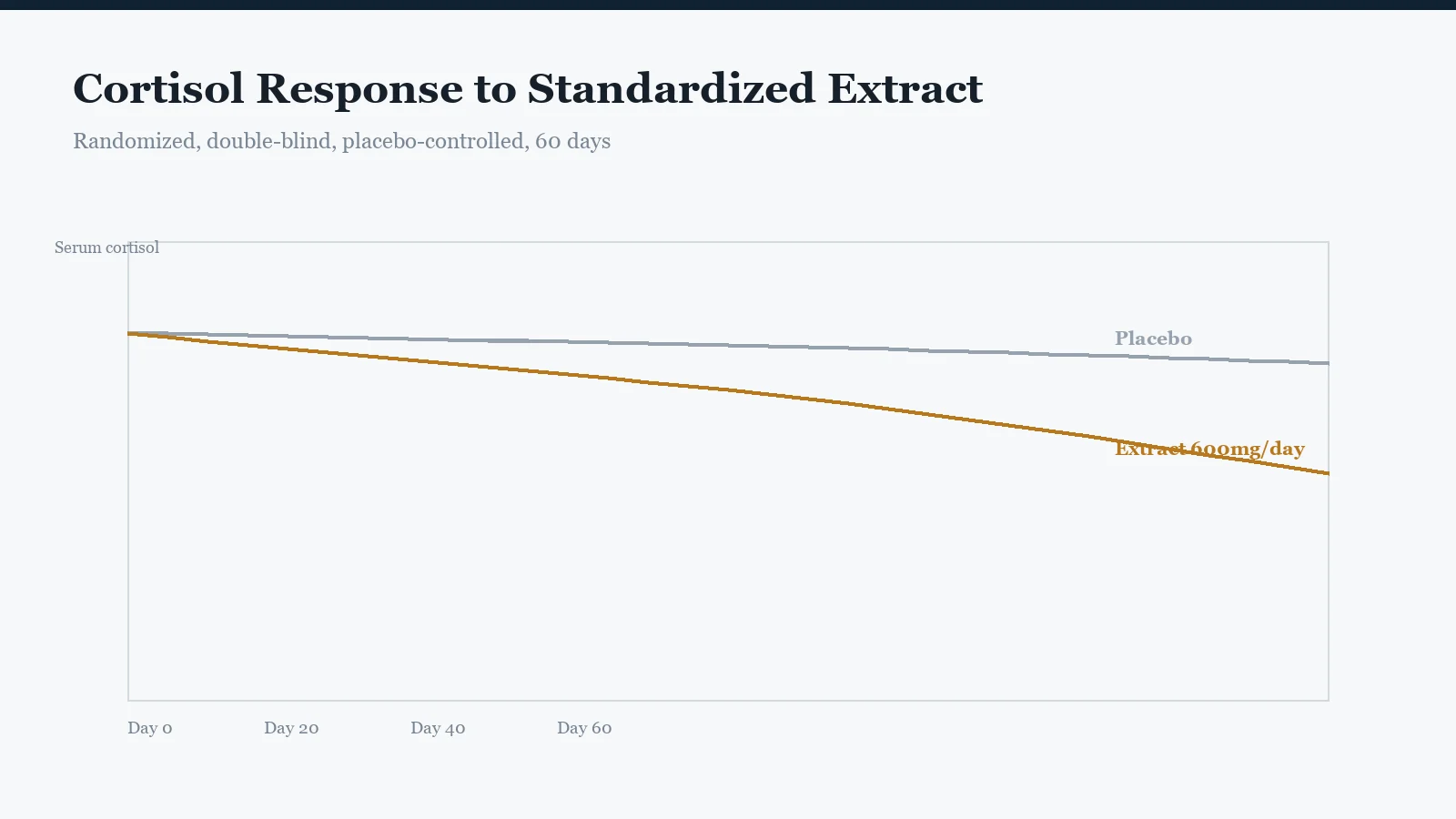
Cortisol and testosterone are functionally antagonistic. Sustained elevation of glucocorticoids suppresses gonadal steroidogenesis at multiple points along the hypothalamic-pituitary-gonadal axis. Any intervention that reliably lowers chronic cortisol therefore has a plausible indirect route to supporting testosterone.
Ashwagandha, Withania somnifera, is the botanical with the strongest human evidence for that first step.
The trial evidence
The most cited study is a randomized, double-blind, placebo-controlled trial in 64 adults with chronic stress. Participants receiving 300mg of a standardized root extract twice daily for 60 days showed a reduction in serum cortisol of approximately 28% relative to baseline, alongside significant improvements in perceived stress scores.1
This is not an isolated result. A 2019 crossover trial in overweight men aged 40 to 70 reported improvements in DHEA-S and testosterone alongside reduced fatigue,2 and a separate 2019 study found dose-dependent cortisol reductions at 250mg and 600mg daily.3 A 2022 systematic review and meta-analysis pooling the available randomized trials concluded that supplementation significantly reduced both cortisol and anxiety measures.4
Effective dose from the literature
240 to 600mg per day of root extract standardized to withanolides, typically 5%, taken for a minimum of eight weeks. Trials generally split the dose between morning and evening.
The caveats
- Trial size. Most enrol between 50 and 130 participants over 8 to 12 weeks. Consistent across studies, but not large-scale evidence.
- Funding. Several of the key trials were funded by extract manufacturers. This does not invalidate the findings, but independent replication would strengthen them considerably.
- Baseline dependence. Effects are clearest in participants with elevated baseline cortisol. In men with normal cortisol, expect less.
- Standardization is not optional. The trials used extracts standardized to withanolide content. Generic root powder with no stated percentage is a different material.
How this translates to what is on the shelf
Two label patterns should prompt scepticism. The first is a proprietary "calm" or "stress" blend with no individual ashwagandha dose disclosed, which makes verification impossible. The second is a token 50mg inclusion in a product whose front label emphasises stress support, an order of magnitude below anything that has been studied.
We cover how to identify both patterns in our guide to reading a supplement label, and which commercial formulas disclose a standardized, trial-level dose in the comparative ranking.
References
- Chandrasekhar K, Kapoor J, Anishetty S. A prospective, randomized double-blind, placebo-controlled study of safety and efficacy of a high-concentration full-spectrum extract of ashwagandha root in reducing stress and anxiety in adults. Indian Journal of Psychological Medicine. 2012;34(3):255-262.
- Lopresti AL, Drummond PD, Smith SJ. A randomized, double-blind, placebo-controlled, crossover study examining the hormonal and vitality effects of ashwagandha in aging, overweight males. American Journal of Men's Health. 2019;13(2).
- Salve J, Pate S, Debnath K, Langade D. Adaptogenic and anxiolytic effects of ashwagandha root extract in healthy adults: a double-blind, randomized, placebo-controlled clinical study. Cureus. 2019;11(12):e6466.
- Akhgarjand C, Asoudeh F, Bagheri A, et al. Does ashwagandha supplementation have a beneficial effect on the management of anxiety and stress? A systematic review and meta-analysis of randomized controlled trials. Phytotherapy Research. 2022;36(11):4115-4124.